Current Project:
Managing Unattended Children in a Retail Environment
This section highlights instructional design projects that are currently in development. You can follow the project’s progress using the interactive progress bar below. As the work evolves, I’ll continue to update this space with insights, artifacts, and reflections from each phase of the design process.
The Problem
A local children’s retail store has been experiencing frequent challenges related to children being left unsupervised while their caregivers shop. These situations sometimes lead to safety concerns, disruptions on the sales floor, and uncertainty among staff about how to respond.
The store’s manager reached out for support after noticing patterns across shifts and seeing the impact on both employees and customer experience. This project focuses on helping the staff respond consistently, confidently, and proactively when these situations arise.
My Process
Needs Analysis
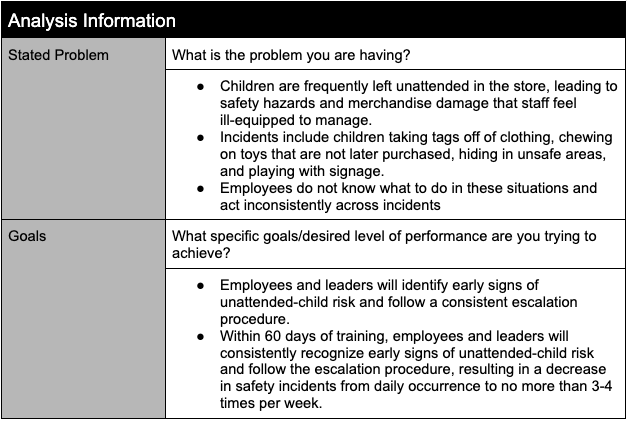
To understand the scope of the issue, I began by meeting with the store’s manager and discussing what she observes on the sales floor. We talked about when these situations tend to happen, how employees currently react, and what the ideal response would look like.
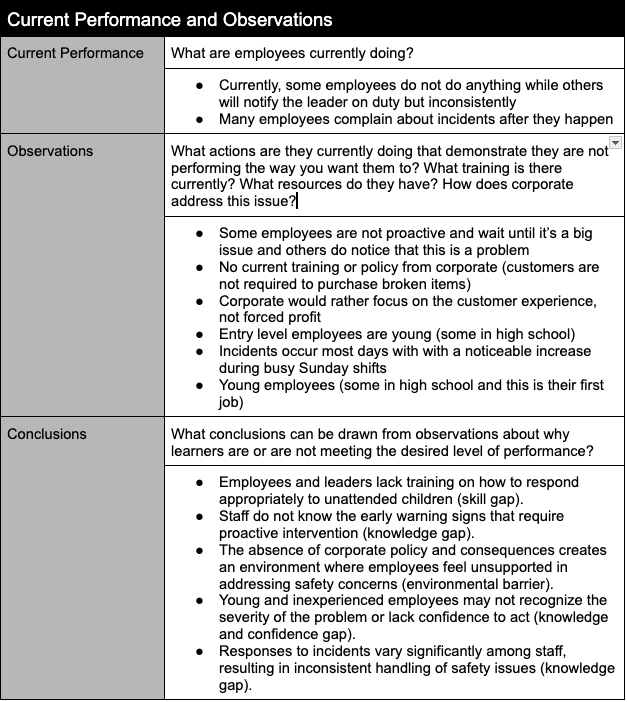
I also explored the store environment, staffing structure, and the expectations employees believe they are supposed to follow. Through this process, I developed a clearer picture of the performance gap: employees want to respond appropriately when children are left unattended, but they lack clarity, confidence, and guidance on what to do.
This phase allowed me to define the problem from both a performance and a safety standpoint and to identify where training can make the most impact.
Action Mapping
After completing the needs analysis, I moved into the action mapping phase of this project. Rather than jumping straight into designing training content, I focused on clearly defining what employees and leaders need to do differently on the sales floor to improve safety and consistency.
Using insights from conversations with the store manager, I created an action map to connect the business goal to specific, observable behaviors and the conditions needed to support them.
At the center of the action map is a measurable outcome:
Within 60 days of training, employees and leaders will consistently recognize early signs of unattended children and follow the escalation procedure, resulting in a 50% reduction in safety incidents.
This goal keeps the focus on real-world performance rather than just knowledge acquisition, and it provides a clear way to evaluate whether the solution is effective.
From there, I worked with the store manager to identify the key behaviors that would lead to this outcome. These include employees and leaders being able to:
Recognize early signs of unattended children
Follow a consistent escalation procedure
Act confidently and appropriately in real-time situations
Communicate effectively with children and caregivers
Document and report incidents accurately
Proactively monitor high-risk areas of the store
Support peers in following established procedures
For each behavior, I brainstormed a range of possible learning strategies, including:
Scenario-based practice
Role play
Job aids
Short e-learning modules
In-person walkthroughs and coaching
At this stage, the goal was to explore options broadly before narrowing down the most effective and realistic solutions for a young, entry-level workforce in a fast-paced retail environment.
Reflection: What the Action Map Revealed
Creating this action map clarified that the solution to this problem is multi-faceted. The learning experience must support both managers and entry-level employees, many of whom are high-school or college-aged and new to the workforce.
The action map also highlighted the need for a blended solution that includes multiple learning and performance support tools rather than a single training event. With this foundation in place, I’m ready to move into the design phase and begin shaping the learning experience.
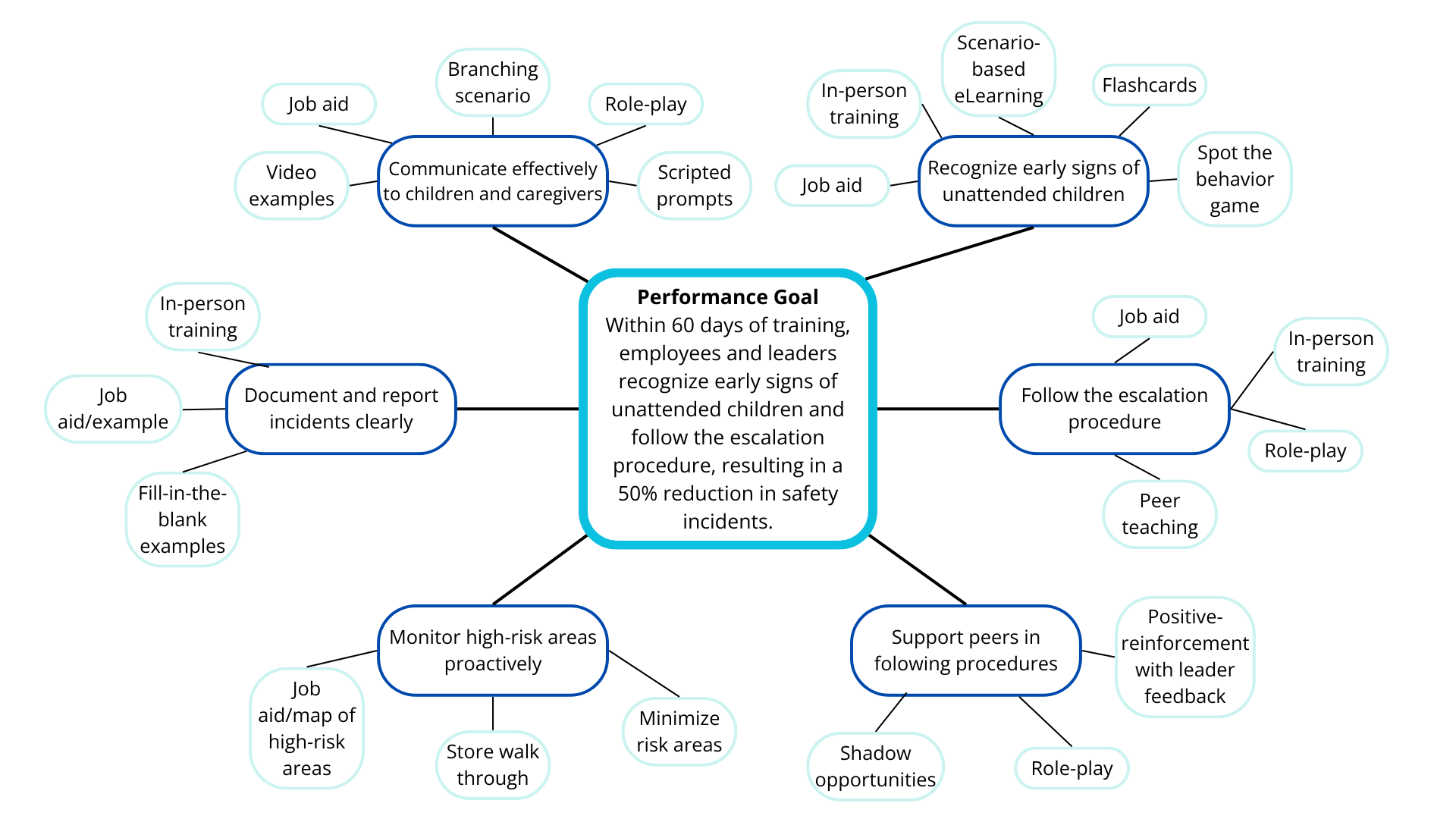
Click image to view Action Map PDF
Learning Solution Plan
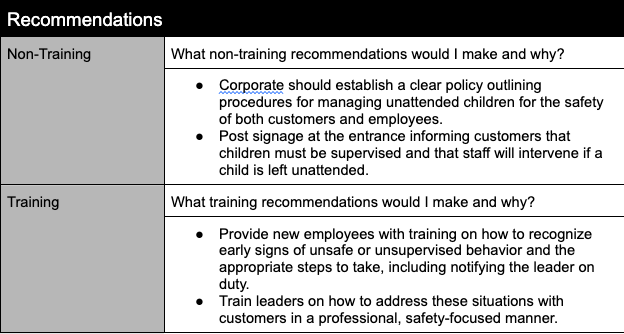
Based on the action map and identified problem, this learning solution will include:
In-Person Training: Introduces early signs of unattended children, the escalation procedure, and effective communication with families.
Job Aid: Summarizes early warning signs, escalation steps, a communication script, and a high-risk area map of the store.
Flashcards: Short scenarios and questions for quick skill practice before shifts.
Because this store has high employee turnover and a large seasonal workforce, the in-person training will be designed to be short, easy to facilitate, and integrated into new-employee on-boarding. Materials are straightforward and clear, tailored to high-school and college-age employees.
Style Guide
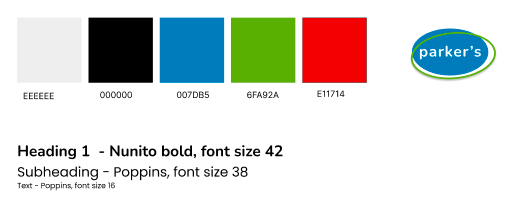
I created a style guide in Figma to ensure visual consistency and accessibility. Colors were tested using WCAG guidelines and passed with white backgrounds; red will be avoided for text. Fonts and logo placement are included to maintain a cohesive look across learning materials.
Note: The company and logo are fictional for privacy purposes.