
Coaching Under Pressure:
Using the GROW Model to Improve Performance and Patient Care
A multi-path, scenario-based learning experience where leaders practice real coaching conversations using the GROW model and apply decisions that impact patient care, team workflow, and results.
Audience: People managers at Gilbert’s, a fast-paced brick-and-mortar pharmacy chain
Responsibilities: Learning experience design, content refinement, scenario and interaction design, feedback development, and visual design decisions
Tools Used: Mindsmith, Canva
The Challenge
Pharmacy managers operate in fast-paced environments where they must balance patient care, accuracy, and efficiency while also supporting team performance. Coaching conversations can easily become directive or reactive, especially during busy shifts.
The challenge was to design a learning experience that helps managers:
Structure coaching conversations using the GROW model
Navigate employee resistance
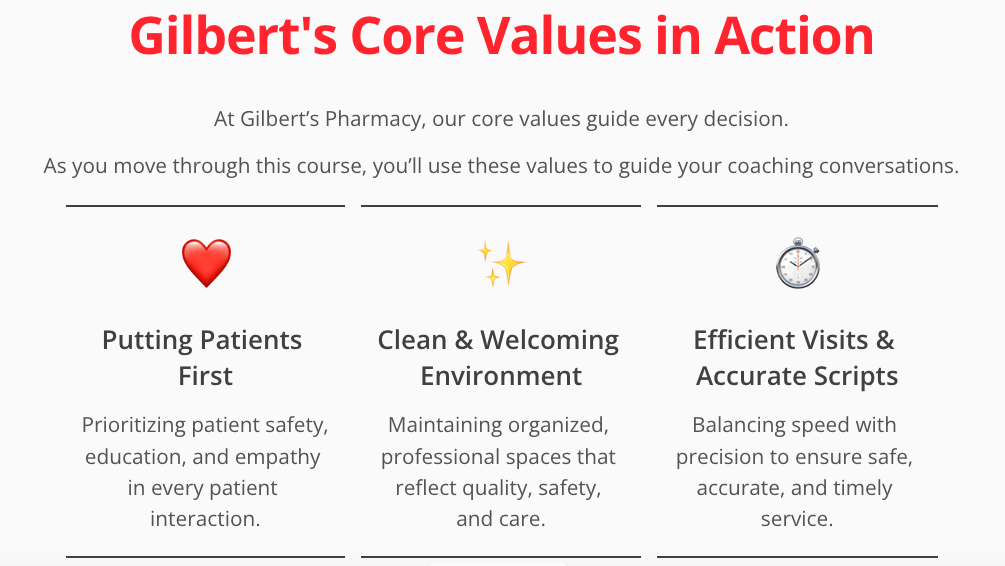
Connect performance improvement to organizational values
I designed this course to prioritize application over information and to reflect how coaching happens in real workplace settings. Learners engage in realistic scenarios with varying levels of support based on their familiarity with the GROW model, allowing them to build confidence through practice. I also intentionally wove Gilbert’s core values throughout the experience to create a meaningful connection between coaching decisions and real workplace impact.
My Process
Tools Used
I developed this course using Mindsmith, an AI-native eLearning authoring tool. Because Mindsmith handled much of the technical build, I was able to focus more deeply on learning design—particularly the structure of scaffolded learning paths and the flow of the learner experience. For example, creating differentiated learning paths based on learner confidence, which would typically require significant development time, was quickly generated and then refined to support usability and clarity.
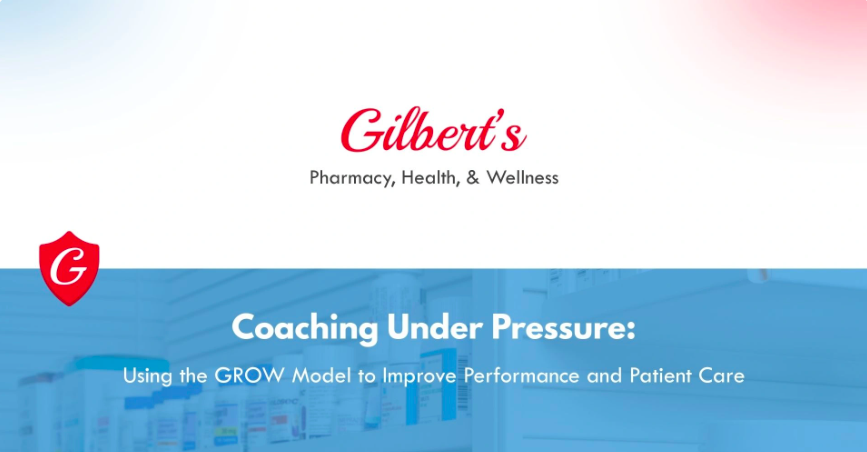
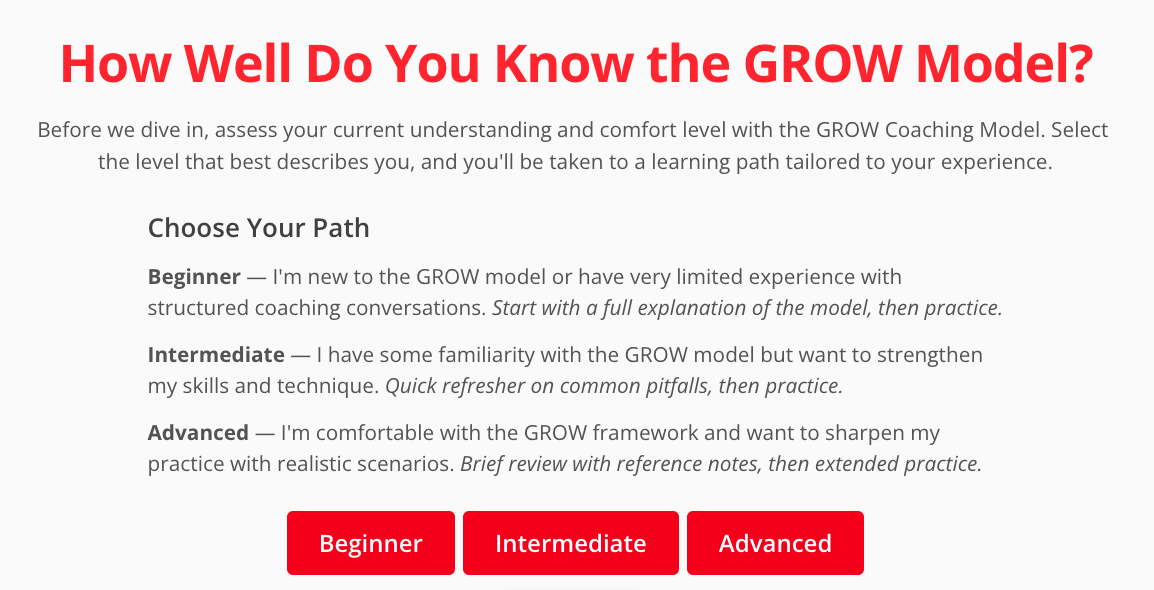
One limitation I encountered was image customization. To address this, I used Canva to design custom visuals that aligned with the course’s tone and branding, and then imported them into Mindsmith. The introduction screen, for example, was designed in Canva to create a more polished and intentional first impression.
Design Decisions
Scaffolded Learning Paths
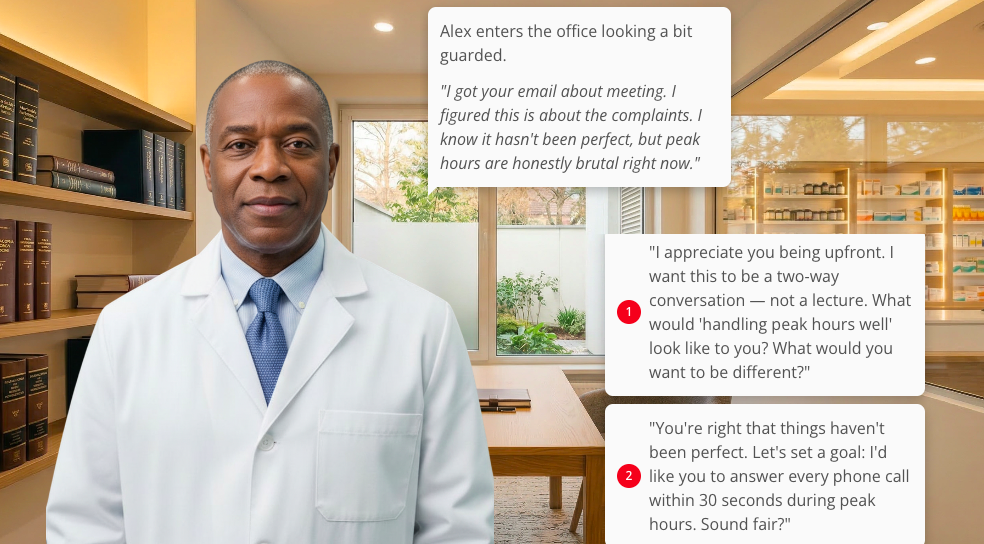
To support learners with varying levels of experience, I designed three learning paths (Beginner, Intermediate, Advanced) that adjust the level of guidance and support. Learners who are newer to the GROW model receive more structured instruction and guided practice, while more experienced learners engage in open-ended application through AI interaction. This approach draws on scaffolding and differentiation, allowing learners to build confidence within their zone of development while avoiding unnecessary cognitive overload.
Feedback and Iteration
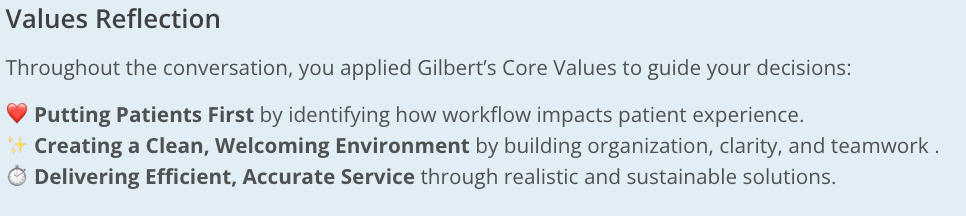
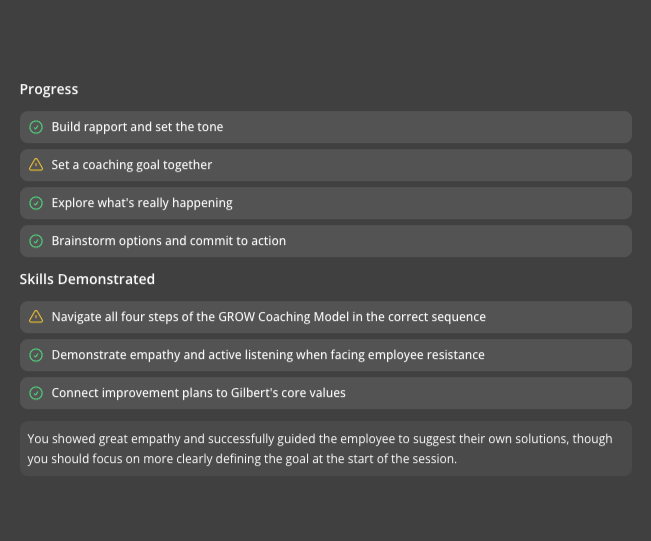
Throughout the experience, learners receive immediate, targeted feedback on their decisions. In the Beginner and Intermediate paths, structured feedback reinforces effective coaching behaviors, while the Advanced path provides more open-ended evaluation through AI interaction. This creates opportunities for reflection and iteration, which are critical for skill development. The goal is not perfection on the first attempt, but growth through practice and feedback.
Learner-Center Flexibility
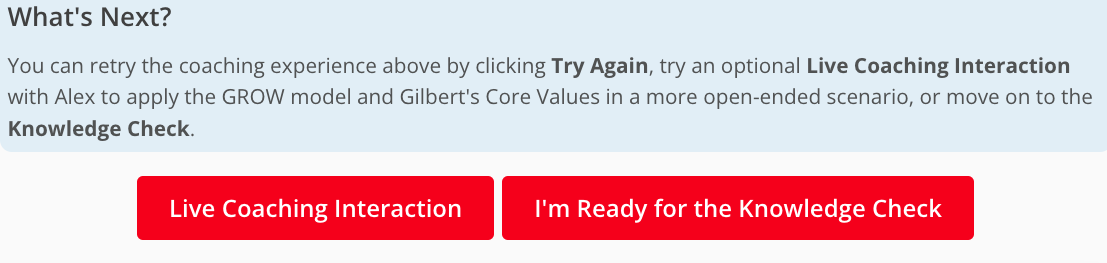
Learners are given choice and control throughout the experience, including the ability to select their starting path and optionally engage in additional AI-based practice. This aligns with adult learning principles, recognizing that learners bring prior experience and benefit from autonomy. By allowing learners to challenge themselves at their own pace, the experience becomes more relevant, engaging, and effective.
Scenario-Based Practice
Rather than focusing on passive instruction, I centered the learning experience around realistic coaching scenarios. Learners practice navigating employee resistance, making decisions, and seeing the impact of their choices in context. This approach is grounded in experiential and situated learning theory, where skills are developed through authentic practice. By simulating real workplace conversations, the learning is more likely to transfer to on-the-job performance.
Values Integration
A key design decision was to intentionally embed Gilbert’s core values throughout the learning experience, rather than presenting them as a separate concept. Learners are consistently prompted to consider how their coaching decisions impact patient care, team environment, and workflow efficiency. This supports meaningful learning by connecting abstract concepts to real organizational priorities, increasing the likelihood that learners apply these behaviors in their day-to-day work.
Key Takeaways
This project pushed me to be more intentional with my design decisions. Because the technical build was supported by AI, I was able to focus more on how the learning actually unfolds—thinking through structure, practice opportunities, and how each piece supports the learner. That shift felt really meaningful and is something I want to carry into future work.
Designing multiple learning paths reinforced the importance of meeting learners where they are. Not every learner needs the same level of support, and building in that flexibility created a more personalized and realistic learning experience.
Intentionally weaving Gilbert’s core values throughout the course helped me think more deeply about how learning connects to real workplace expectations. Instead of treating values as something separate, I focused on embedding them into decisions and feedback so they felt like a natural part of the work.
This project also strengthened my focus on creating practical, scenario-based experiences that mirror real conversations. My goal was to make the learning feel useful and applicable right away, and that’s an approach I plan to continue building on.